

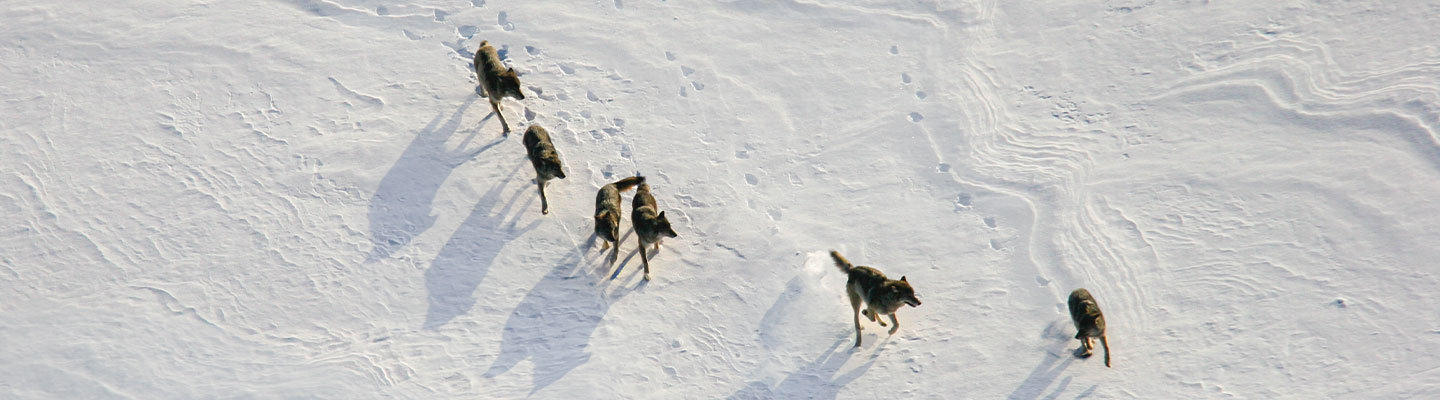

Aerial view of a wolf pack that runs across a snow-covered landscape

The ideal population of wolves on Isle Royale is more than 20.

© Handout/TNS via ZUMA Press Wire

Standards

The Wolves of Isle Royale

For nearly 70 years, scientists have studied how populations boom and bust on a Great Lakes island.

Near the border of the U.S. and Canada, 20 miles off the coast of Minnesota, is Isle Royale National Park. This 134,000-acre island is in Lake Superior and is part of Michigan. Its remote location makes it one of the least-visited national parks. In fact, only 29,000 people visit each year. Some of these visitors are scientists working on a decades-long research project studying wolves.

For nearly 70 years, scientists have trekked to the remote island to count the wolves and their prey: moose. Volunteers for a program called Moosewatch have joined them for the past 18 years. They collect moose bones to figure out how the animals died, whether they were healthy, and how old they were. The large group of volunteers gathers more data than just a few biologists could collect themselves. Last April, I got to tag along. I saw wolf scat and moose droppings along walking paths, clear evidence of the relationship between predator and prey.

Isle Royale National Park isn’t easy to visit. The 134,000-acre island is in Lake Superior, near the border of the U.S. and Canada. It’s 20 miles off the coast of Minnesota, but it’s actually part of Michigan. Its remote location makes it one of the least-visited national parks. Only about 29,000 people go there each year. Some of these visitors are scientists. They’re working on a long-term research project about wolves.

Scientists have trekked to the island for nearly 70 years. They go to count the wolves and their prey: moose. For the past 18 years, volunteers for a program called Moosewatch have joined them. They collect moose bones. The bones help scientists figure out how the animals lived and died. The large group of volunteers gathers more data than a few scientists could alone. Last April, I got to tag along!

The study is one of the longest-running science experiments of predator-prey relationships in history. Over the years, scientists have monitored the changing populations—and even brought help when the wolves almost died out. There are now fewer moose and more wolves on the island than in the history of the study. “We will soon be in uncharted territory,” says Rolf Peterson, the wildlife biologist who has been working on the project since the 1970s. “Wolves once again have the upper hand.”

On Isle Royale, I saw wolf scat and moose droppings along walking paths. It was evidence of what the scientists are studying: the relationship between predator and prey. Over the years, scientists have monitored the populations of wolves and moose. They have even brought help when the wolves almost died out. It’s one of the longest-running science experiments of its kind.

But now there are fewer moose and more wolves on the island than ever. “We will soon be in uncharted territory,” says Rolf Peterson. He’s a biologist who has been working on the project since the 1970s. “Wolves once again have the upper hand,” he explains.

The Wolves and Moose of Isle Royale
Watch a video about the wolves and moose of Isle Royale National Park.

OUT OF BALANCE

Wolves first arrived on Isle Royale almost 80 years ago in the middle of winter. They traveled from the mainland over an ice bridge that formed on Lake Superior. When spring arrived, the bridge melted, leaving the pack stuck on the island. Luckily for the wolves, there were plenty of moose for them to eat, and the pack thrived.

But in the early 2000s, the wolves on Isle Royale weren’t doing well. There were only a few left, and those that remained were closely related. This created a lack of genetic diversity among the wolves, so many new pups suffered from health problems. During some winters, an ice bridge formed over the lake and allowed wolves from the mainland to walk to the island. But warmer winters meant fewer opportunities for new wolves to make the trip.

Meanwhile, the moose population boomed. They munched on balsam fir trees, which kept the trees from growing tall. Some scientists feared the moose were destroying the forest. So they made a bold suggestion: Introduce new wolves to Isle Royale.

Wolves first arrived on Isle Royale almost 80 years ago. It was the middle of winter. They walked from the mainland over an ice bridge that formed on the lake. When spring came, the bridge melted. That left the pack stuck on the island. Luckily for the wolves, there were plenty of moose for them to eat. The predators thrived on Isle Royale.

But in the early 2000s, the wolves weren’t doing well. Only a few were left, and they were closely related to each other. This often caused health problems for new pups that were born. During some winters, an ice bridge formed over the lake again. This allowed new, unrelated wolves from the mainland to walk to the island. But warmer winters meant that happened less often over time.

Meanwhile, the moose population boomed. They ate balsam fir needles, which kept the trees from growing tall. Some scientists feared the moose were destroying the forest. So they made a bold suggestion: Bring new wolves to Isle Royale.

Ron Porritt

Writer Susan Cosier (center) with researcher Rolf Peterson (right) and his wife, Candy, who organizes Moosewatch

“When you’re actually out in the field and you spend time observing animals and seeing how they interact and what they do, then you’re going to come up with a better interpretation of what the data is showing you,” says Sarah Hoy, a wildlife biologist at Michigan Technical Institute and the project’s current leader.

“When you spend time observing animals and seeing how they interact, you’re going to come up with a better interpretation of the data,” says Sarah Hoy. She’s a biologist at Michigan Technical Institute and the project’s current leader.

National Park Service via AP Images

In 2018, the National Park Service released 19 wolves to boost the population.

REINTRODUCING WOLVES

Nineteen wolves were airlifted from the surrounding area and brought to Isle Royale in 2018. These new transplants had plenty to eat. There were 2,000 moose on the island. There was also plenty of space for the wolves to establish at least a couple of packs. Now the wolves are thriving. At last count, 37 wolves now live on Isle Royale in three separate packs.

In the winter, scientists fly over the island to see where wolves have hunted and killed prey. Then, in the spring and summer, volunteers go to those places. I joined a group to look for moose remains. We trudged through bogs and climbed over tree limbs looking for exposed antlers and bones. In less than a week, we found bones from nearly a dozen moose!

Nineteen wolves from the mainland were flown to Isle Royale in 2018. These new residents had plenty to eat. There were 2,000 moose on the island. There was also plenty of space for the wolves to break into packs. Now the island’s wolves are thriving. At last count, there were 37 wolves living in three separate packs.

In the winter, scientists fly over the island. They look for areas where wolves have killed prey. In the spring and summer, volunteers go to those places. I joined a group to look for moose remains. We hiked through bogs and climbed over tree limbs. We were looking for exposed antlers and bones.

“Wolves once again have the upper hand.”

When someone from the group spotted a moose skull, one person would cut out a tooth and put it in a small plastic bag. In a lab, researchers use it to determine a moose’s age. Someone also scoops out bone marrow—the soft spongy tissue inside most bones where blood cells are made. Bone marrow can show whether the moose was starving. There was still plenty to find even though the moose population had fallen to 500 in the past five years.

When someone spotted a moose skull, they alerted the rest of the group. One person cut out a tooth and put it in a bag. Later, in a lab, scientists would use it to determine the moose’s age. Someone also scooped out some bone marrow. That’s the soft spongy tissue inside most bones. Bone marrow can show whether the moose was starving.

By the time I visited, the moose population had fallen to 500. Still, in less than a week, we found bones from nearly a dozen moose!

Susan Cosier

Moosewatch volunteers look for moose bones to track the population.

TO BE CONTINUED

Researchers plan to continue studying how the changing wolf and moose populations influence the entire ecosystem. Their work has also led to even more questions. Some scientists involved with the project are now investigating the effects on vegetation. Scientists are measuring tree growth to see how quickly the balsam fir trees recover after years of overgrazing.

They’re also looking more closely at the moose population. Recent DNA analyses from bones collected suggest that the moose may now be too closely related too, which could affect their long-term health.

One thing’s for certain: The wolves, the bones, and the balsam firs will continue to tell the story to researchers and volunteers for years.

Scientists plan to continue studying Isle Royale’s wolf and moose populations. They want to know how the changes affect other living things on the island. Their work has led to even more questions. Some of the scientists are now investigating the effects on plant life. With fewer moose to eat them, balsam fir trees are regrowing. Scientists are measuring them to see how quickly they recover.

They’re also looking more closely at the moose population. Data from bones shows that the moose may now be too closely related too. That could affect the long-term health of the population. One thing’s for sure: The wolves, moose bones, and balsam firs will continue to interest scientists and volunteers for many years to come. 

John Vucetich

A pack of wolves stalks a moose on Isle Royale.

Understanding Inequalities
Watch an instructional video about inequalities.

Test the solutions for the algebraic equations and inequalities based on information about the moose-wolf study on Isle Royale. Record your work and answers on the Your Turn sheet.

Test the solutions for the algebraic equations and inequalities based on information about the moose-wolf study on Isle Royale. Record your work and answers on the Your Turn sheet.

The inequality m < 1,000 represents the ideal moose population. In which years was the inequality true?

The inequality m < 1,000 represents the ideal moose population. In which years was the inequality true?

The inequality c > 14% represents the ideal percent of the total moose herd that are young calves. Which values in the chart make the inequality true?

The inequality c > 14% represents the ideal percent of the total moose herd that are young calves. Which values in the chart make the inequality true?

The equation 650 = 500 + 25y represents the moose population goal, where y is the number of years from now. In how many years should the moose population reach scientists’ goal?

The equation 650 = 500 + 25y represents the moose population goal, where y is the number of years from now. In how many years should the moose population reach scientists’ goal?

The equation 40 ≤ 37 + 2p represents the ideal wolf population growth, where p is the number of years from now. In how many years should the wolf population hit the goal?

The equation 40 ≤ 37 + 2p represents the ideal wolf population growth, where p is the number of years from now. In how many years should the wolf population hit the goal?

A. The ideal number of wolf packs is at least 2. Write an inequality to represent this using the variable n to represent the number of wolf packs.

A. The ideal number of wolf packs is at least 2. Write an inequality to represent this using the variable n to represent the number of wolf packs.

B. Evaluate the inequality you wrote in Part A for the number of packs over the years.

B. Evaluate the inequality you wrote in Part A for the number of packs over the years.

C. How do you think using equations and inequalities to track the populations of wolves and moose can help scientists?

C. How do you think using equations and inequalities to track the populations of wolves and moose can help scientists?

videos (2)
videos (2)
Skills Sheets (4)
Skills Sheets (4)
Skills Sheets (4)
Skills Sheets (4)
Lesson Plan (1)
Article (1)
Text-to-Speech