

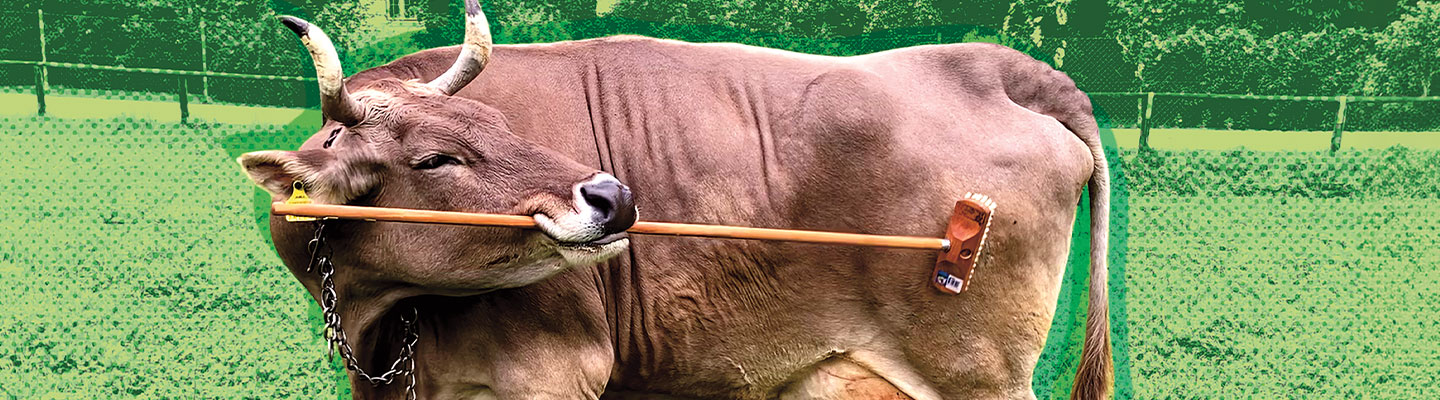

A large horned cow with a measuring rod across its body in a green field

Veronika the cow uses a brush to scratch an itch.

Antonio J Osuna Mascaro

Standards

The Right Tool for the Job

From cows to chimps to vultures, meet some animals that have figured out how to use tools!

Animal Brainpower
Watch a video to learn more about how animals think.

When Veronika feels an itch on her back, she reaches for her trusty back scratcher. But Veronika isn’t a person—she’s a cow! The 12-year-old Swiss brown cow lives in Austria and uses brooms and rakes as back scratchers. When her back gets itchy, Veronika wraps her supersized tongue around the handle of a nearby broom or rake, hauls it into her mouth, and maneuvers the other end of her tool to the itchy spot. After a few scratches, the itch is gone! Veronika’s back-scratching skills have earned her a place on the growing list of animals known to use tools. 

To be considered a tool user, an animal must be seen picking up or moving an object and using it to perform a task “that would otherwise be difficult or impossible to achieve,” says Alice Auersperg. She’s a biologist at the University of Veterinary Medicine in Vienna who studied Veronika’s tool use. Auersperg says more than 250 species are known to use tools! Read on to meet some other tool-using animals whose ingenuity has astounded scientists. 

When Veronika’s back feels itchy, she reaches for her back scratcher. But Veronika isn’t a person. She’s a cow! Veronika lives in Austria and uses brooms and rakes to scratch her back. She wraps her huge tongue around the handle and pulls it into her mouth. Then she guides the other end of her tool to the itchy spot. After a few scratches, the itch is gone! Veronika’s back-scratching skills are impressive. And they’ve earned her a place on the growing list of animals known to use tools. 

What counts as using a tool? An animal must be seen picking up or moving an object. Then it has to use the object to perform a task “that would otherwise be difficult or impossible,” says Alice Auersperg. She’s a biologist at the University of Veterinary Medicine in Vienna. She studied Veronika’s tool use.

Auersperg says more than 250 species are known to use tools! Read on to meet some other animals that have astounded scientists with how they do it. 

See Veronkia the Cow Use Her Brush
Watch a video about Veronika the cow using a tool to scratch her back

Write and evaluate expressions about animals that use tools.  Record your work and answers on our answer sheet.

Write and evaluate expressions about animals that use tools.  Record your work and answers on our answer sheet.

Writing Algebraic Expressions
Watch an instructional video about writing algebraic expressions.

EGG SMASHERS

Imagebroker.com/Alamy Stock Photo

Egyptian vultures throw rocks at ostrich eggs.

Mario Elias Munoz Valencia/Getty Images

The shell of an ostrich egg can be 4 millimeters thick!

Ostrich eggs make a large and nutritious meal for those who can crack the eggs’ thick shells. The shells can be as thick as a pane of glass and often won’t break if an adult human sits on one. There have even been reports of lions struggling to smash the eggs with their jaws! However, one bird has figured out how to use rocks to break these tough shells to reach the tasty treat inside. 

Egyptian vultures are chicken-sized scavengers found in North Africa, West Asia, India, and southwestern Europe. The birds pick up stones with their beaks and fling them at ostrich eggs until they crack. But these birds won’t use just any old stone; they prefer rounded rocks and will travel great distances—sometimes even miles—to find them! Ostriches lay more eggs than they can care for. When one rolls out of the nest, Egyptian vultures seize the opportunity and get smashing.

Ostrich eggs can be a large and nutritious meal. But you have to crack their thick shells first. The eggshells can be as thick as a pane of glass. The shells often won’t break if an adult human sits on them! Even lions have struggled to smash the eggs with their jaws. But one bird has figured out how to use rocks to break the shells and reach the tasty treat inside. 

Egyptian vultures live in North Africa, West Asia, India, and southwestern Europe. They’re about the size of chickens. The birds pick up stones with their beaks. Then they fling them at ostrich eggs until the shells crack. But these birds won’t use just any stone. They prefer rounded rocks. They sometimes travel miles to find just the right one! Ostriches lay more eggs than they can care for. When one rolls out of the nest, Egyptian vultures seize their chance and get smashing.

A. It takes an average of 8 stone tosses for a vulture to break open an egg. Write an expression for how many tosses it would typically take to break open e eggs.

A. It takes an average of 8 stone tosses for a vulture to break open an egg. Write an expression for how many tosses it would typically take to break open e eggs.

B.  Evaluate it! How many tosses would it typically take to break open 5 eggs?

B.  Evaluate it! How many tosses would it typically take to break open 5 eggs?

OCTOPUS ARMOR

Alex Mustard/NPL/Minden Pictures

A coconut octopus hides out in a coconut shell.

Alex Mustard/naturepl.com

This octopus carries its shell while walking on the seafloor.

The coconut octopus would much rather eat a crab or a clam than the fruit the animal’s named after. Its name actually comes from its use of coconut shells as tools. This octopus spends much of its life carrying coconut shells. While the shell makes an excellent hiding spot from predators, scientists have found that these creatures also use the shells as tools for defense. That makes them the first invertebrates—or animals without backbones—known to use tools. Predators not fooled by the disguise have to break through the shell, which can be tougher to crack than a human skull. The size, shape, and sturdiness of coconut shells make them a perfect multipurpose tool for the coconut octopus. Not only does it use them for armor and camouflage, but they’re also a perfect shelter and nursery spot for eggs!

Despite its name, the coconut octopus doesn’t eat coconuts. It would much rather munch on a crab or a clam. But this octopus does use coconut shells as tools. It actually spends much of its life carrying the shells around! Coconut shells make an excellent hiding spot from predators. Scientists have found that the octopuses use them as armor too. They’re the first invertebrates—or animals without backbones—known to use tools. 

A predator may notice the octopus inside a coconut shell. But it would have to break through the shell to eat the invertebrate. Coconut shells can be tougher to crack than a human skull! Their size, shape, and sturdiness make them a perfect tool for the coconut octopus. The animals even use the shells as nurseries for their eggs!

A. Scientists discovered that coconut octopuses prefer coconut shells that are 2 times b, the length of their bodies. Write an expression to find the ideal shell length for a coconut octopus.

A. Scientists discovered that coconut octopuses prefer coconut shells that are 2 times b, the length of their bodies. Write an expression to find the ideal shell length for a coconut octopus.

B.  Evaluate it! What’s the ideal shell length for a 3.21-inch-long coconut octopus?

B.  Evaluate it! What’s the ideal shell length for a 3.21-inch-long coconut octopus?

FISHING FOR BUGS

Shutterstock.com

On average, a chimp can fish 5 termites out of a nest per attempt.

Shutterstock.com

Termites

Of all the nonhuman animals known to use tools, no species uses more than the chimpanzee. This highly intelligent primate uses dozens of tools, like stones to crack nuts, absorbent leaves to transport water, and sticks and blades of grass to fish termites out of nests. 

Termite “fishing” was discovered in 1960 by primatologist Jane Goodall. She observed chimps plucking long blades of grass, sticking them into termite nests, and eating the termites that climbed onto the grass. This was the first documented case of an animal using a tool—something thought to be unique to humans. When Goodall told her mentor Louis S. B. Leakey, a paleoanthropologist who studied early humans, about her discovery, he said, “Now we must redefine ‘tool,’ redefine ‘man,’ or accept chimpanzees as human.”

There are many animals known to use tools. But apart from humans, chimpanzees use them the most. The extremely smart apes use dozens of different tools. These include stones to crack nuts, leaves to transport water, and sticks or blades of grass to fish termites out of nests. 

Termite “fishing” was discovered by primatologist Jane Goodall. She first observed it in 1960. Chimps would pluck long blades of grass and stick them into termite nests. Then they would eat the termites that climbed onto the grass. This was the first recorded case of an animal using a tool. Until then, scientists thought only humans could do so. Goodall told her mentor, Louis S. B. Leakey, about her discovery. He studied early humans. “Now we must redefine ‘tool,’ redefine ‘man,’ or accept chimpanzees as human,” he said.

A. In one study, chimps spent an average of 10 minutes fishing with their tool per attempt, a, before removing their tool from the nest. They successfully caught termites 4/5 of the time. Write an expression to find the number of attempts a chimp in the study was unsuccessful in catching termites.

A. In one study, chimps spent an average of 10 minutes fishing with their tool per attempt, a, before removing their tool from the nest. They successfully caught termites 4/5 of the time. Write an expression to find the number of attempts a chimp in the study was unsuccessful in catching termites.

B.  Evaluate it! Out of 15 attempts, how many would you expect to be unsuccessful?

B.  Evaluate it! Out of 15 attempts, how many would you expect to be unsuccessful?

videos (3)
videos (3)
videos (3)
Skills Sheets (3)
Skills Sheets (3)
Skills Sheets (3)
Lesson Plan (1)
Article (1)
Text-to-Speech