

Christopher Payne/Esto/Redux

STANDARDS

CCSS: 6.RP.A.3.D, MP6

TEKS: 6.4H, 7.4E

Standards

And The Oscar Was Made By . . .

Jake Joyce and a team of metal artists create Hollywood’s most famous golden statue.

Christopher Payne/Esto/Redux

The biggest night in movies this year is March 15, when millions will tune in to watch the Oscars®. Although we don’t know which films, actors, and crew will take home the top honors, one star of the show is always the same: the Oscar® statuette. This iconic trophy is handcrafted by a team of 100 artists at UAP, a workshop in Upstate New York. “We work for some of the world’s most famous artists every day,” says Jake Joyce, general manager of UAP. “But the Oscar is the most recognizable object ever.”

UAP—short for Urban Art Projects—is an art foundry. It’s a type of workshop where sculptures are created by molding melted metals. Joyce and his team help artists turn their creative ideas into metal masterpieces. They make everything from small tabletop pieces to large outdoor sculptures you might see in front of a museum or city hall.

The biggest night in movies this year is March 15. That’s when millions of people will watch the Oscars® ceremony. We don’t know yet which films and actors will win the awards. But one star of the show is always the same: the Oscar® statuette. This trophy is known around the world. “The Oscar is the most recognizable object ever,” says Jake Joyce. He’s the general manager of Urban Art Projects (UAP), a workshop in Upstate New York. There, a team of 100 artists makes every Oscar for the big show.

UAP is an art foundry. That’s a type of workshop where melted metals are molded into sculptures. Joyce and his team help artists turn their ideas into metal masterpieces. They make everything from small pieces to large sculptures you might see in front of city hall.

Chris Roque/Courtesy of UAP | Urban Art Projects

Jake Joyce

Joyce has spent nearly 30 years as a foundry artist. Although he originally studied math and physics, Joyce ultimately decided to follow in his father’s footsteps. His father was one of the early employees of UAP. “I just always loved building things with my hands and figuring out how things are made,” he says.

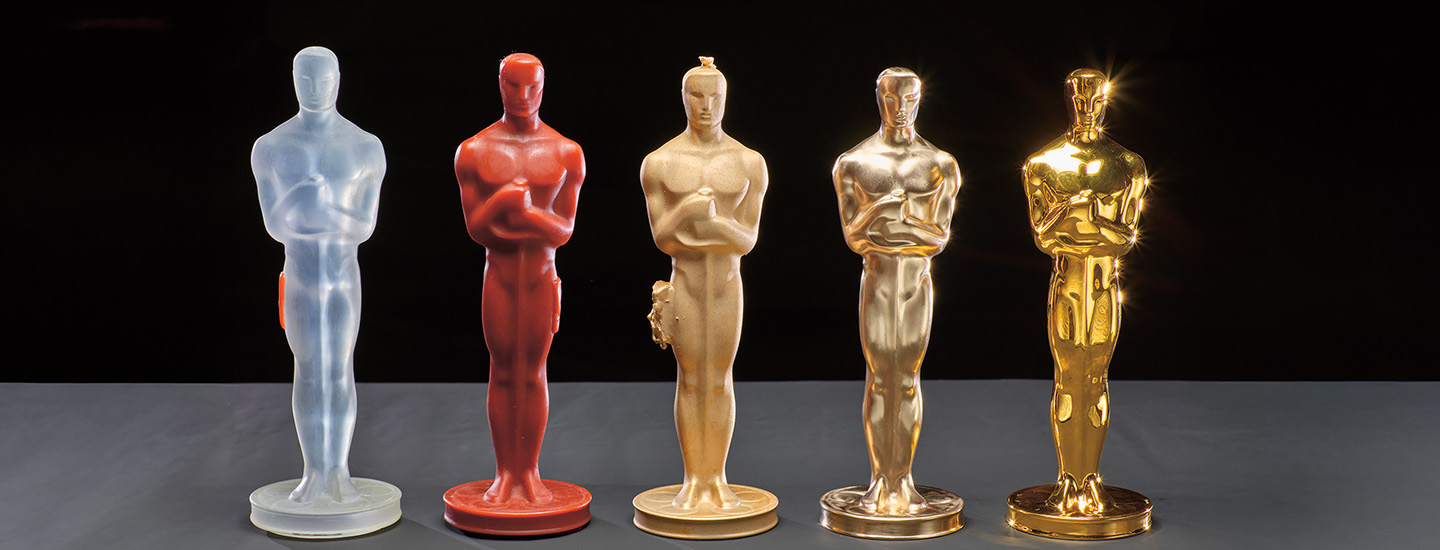
This year is the 10th year UAP has crafted the Oscar statuettes using a 6,500-year-old method called lost wax casting. Each one starts as a wax model. Then it’s coated in ceramic to make a mold. After the wax is melted out, molten bronze heated to 2,000 degrees Fahrenheit is poured in. Once cooled, the shell is broken off and the statue is polished, gold-plated, and mounted on a black base. Then it’s shipped to Los Angeles, California, for the big event.

Joyce has been a foundry artist for almost 30 years. He originally studied math and physics. But then he decided to follow in his father’s footsteps. His father was one of the early employees of UAP. “I just always loved building things with my hands and figuring out how things are made,” says Joyce.

This is the 10th year that UAP has made the Oscar statuettes. They use a 6,500-year-old method called lost wax casting. Each trophy starts as a wax model. It’s then coated in clay to make a mold. The wax is melted out, leaving an empty space. Then artists pour in molten bronze heated to 2,000 degrees Fahrenheit. Once the metal cools, they break off the ceramic shell. The statue is polished, plated with gold, and mounted on a black base. Then it’s shipped to Los Angeles, California, for the big event.

Creating an Oscar involves more than artistry. It also involves precise math. “Metal casting requires many careful calculations,” explains Joyce. His team determines the exact temperature for the bronze, the right mass to melt, and how to design channels so the liquid flows evenly. If the temperature or timing is off, the statue won’t turn out correctly. “It’s like cooking. Everything has to arrive at the table with the appropriate temperature at the appropriate time,” explains Joyce.

While Oscars may be UAP’s most famous commission, they’re just one of hundreds of projects the foundry completes each year. For Joyce, the real reward is knowing these pieces will stand the test of time. “We are creating the works that will be in the art history books of the future,” he says. “What we make will outlast all of us and tell the story of our society.”

Creating an Oscar takes more than artistic skill. It also involves precise math. “Metal casting requires many careful calculations,” explains Joyce. His team determines the exact temperature for the bronze and the right amount to melt. They also have to design channels in the mold so the liquid flows evenly. If the temperature or timing is off, the statue won’t turn out correctly. “It’s like cooking,” says Joyce. “Everything has to arrive at the table with the appropriate temperature at the appropriate time.”

Oscars may be UAP’s most famous job. But they’re just one of hundreds of projects the workshop completes each year. For Joyce, the best part is knowing these pieces will stand the test of time. “We are creating the works that will be in the art history books of the future,” he says. “What we make will outlast all of us and tell the story of our society.”

Converting Metric and Customary Units
Watch this instructional video about converting metric and customary units.

Use this information to convert between units to see what it takes to make an Oscar statuette. Round answers to the nearest hundredth. Round answers to the nearest whole number. Record your work and answers on our answer sheet.

Use this information to convert between units to see what it takes to make an Oscar statuette. Round answers to the nearest hundredth. Round answers to the nearest whole number. Record your work and answers on our answer sheet.

Christopher Payne/Esto/Redux

First, UAP makes wax molds of the statuette. Each weighs 8 ounces. What’s that in grams?

First, UAP makes wax molds of the statuette. Each weighs 8 ounces. What’s that in grams?

Christopher Payne/Esto/Redux

The wax figures are attached to a 0.94-meter-tall device that holds three statuettes at a time. This is dipped into a vat of ceramics to make a mold. How tall is the device in feet?

The wax figures are attached to a 0.94-meter-tall device that holds three statuettes at a time. This is dipped into a vat of ceramics to make a mold. How tall is the device in feet?

Christopher Payne/Esto/Redux

Next, the wax is melted out of the ceramic molds and melted bronze is poured in. Once removed from the molds and cooled, each bronze statuette weighs about 80 ounces. What’s that in kilograms?

Next, the wax is melted out of the ceramic molds and melted bronze is poured in. Once removed from the molds and cooled, each bronze statuette weighs about 80 ounces. What’s that in kilograms?

Christopher Payne/Esto/Redux

The bronze statuette gets polished and then is plated in copper, nickel, and gold. The total thickness is 0.00114 millimeters. What’s that in inches? Do not round your answer.

The bronze statuette gets polished and then is plated in copper, nickel, and gold. The total thickness is 0.00114 millimeters. What’s that in inches? Do not round your answer.

Christopher Payne/Esto/Redux

The final metal statuette measures 34.29 cm tall. The last step is mounting it on a pedestal, which is 3 inches tall. What’s the entire height of the award in feet? Do not round your answer.

The final metal statuette measures 34.29 cm tall. The last step is mounting it on a pedestal, which is 3 inches tall. What’s the entire height of the award in feet? Do not round your answer.

videos (1)
Skills Sheets (5)
Skills Sheets (5)
Skills Sheets (5)
Skills Sheets (5)
Skills Sheets (5)
Games (1)
Lesson Plan (1)
Article (1)
Text-to-Speech