

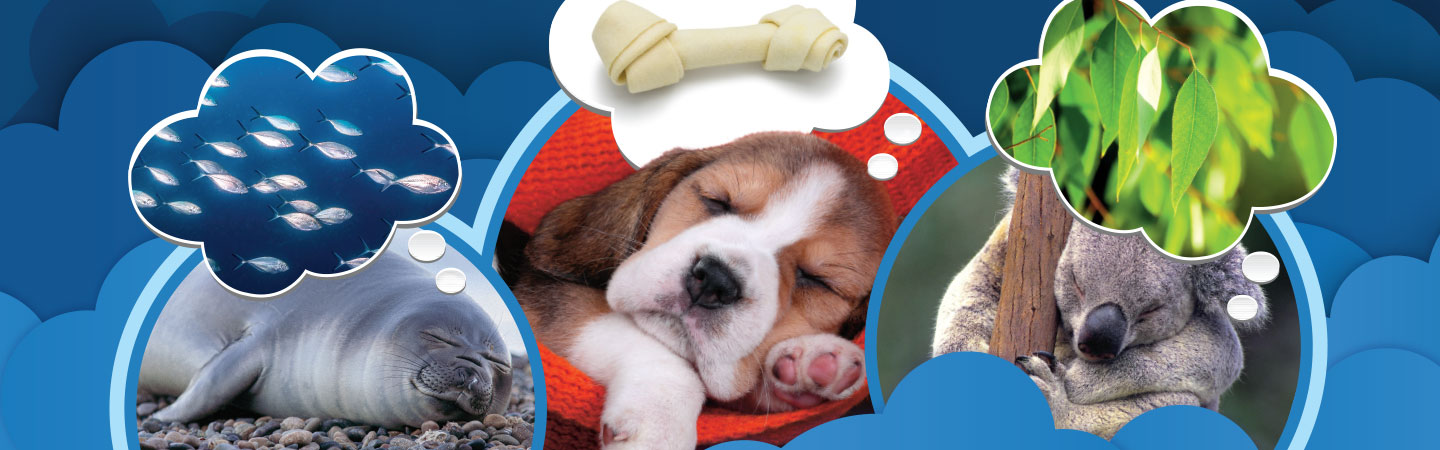

iStockPhoto/Getty Images (Seal); Shutterstock.com (Puppy); Aflo/NaturePL.com (Koala)

STANDARDS

CCSS: 7.EE.B.4, MP2

TEKS: 7.11A, 7.10A

Standards

Do Animals Dream?

Scientists are investigating what happens when animals sleep.

A dog lies on the couch, fast asleep. Suddenly, his legs start to twitch like he’s running, and he lets out a muffled bark. The pup must be dreaming, but about what? Chasing a squirrel? Playing fetch?

Many scientists have wondered the same thing—and not just about dogs. There are more than 2 million known animal species, and almost all of them sleep—and likely dream as well. “If you were to ask me ‘Do all animals dream?,’ I would say yes,” says Phillippe Mourrain, a biologist who studies sleep.

A dog sleeps on the couch. Suddenly, his legs start to twitch. It looks like he’s running. He even lets out a little bark. The pup must be dreaming, but about what? Chasing a squirrel? Playing fetch?

Many scientists have wondered the same thing—and not just about dogs. There are more than 2 million known animal species. Almost all of them sleep. That means they likely dream too. “If you were to ask me ‘Do all animals dream?,’ I would say yes,” says Phillippe Mourrain. He’s a biologist who studies sleep.

The Science of Snoozing
Watch this video about the science of the sleep habits of animals.

Scientists don’t know why animals—including humans— need to sleep, let alone dream. But they do know that sleep affects the connections between specialized nerve cells in the brain called neurons. During sleep, your brain processes experiences from the day and prepares for tomorrow. As this happens, connections between neurons form, break, and rearrange to help store memories and create new associations. This reshuffling may produce images and sensations—what we call dreams.

But animals can’t tell scientists what they dream about. So to study animals dreaming, researchers need to get creative. Read on to learn how scientists have delved into the dream worlds of three very different animals.

Scientists don’t know exactly why animals—including humans—need to sleep or dream. But they do have a few clues. During sleep, your brain processes experiences from the day and prepares for the next day. This changes the links between brain cells called neurons. Connections form, break, and rearrange to help store memories and create new mental links. This process may trigger images and feelings—what we call dreams.

But animals can’t tell scientists what they dream about. So researchers need to get creative. Read on to learn how scientists have explored the dreams of three very different animals. 

Understanding Inequalities
Watch an instructional video about inequalities.

Write and solve algebraic inequalities to learn more about different animals’ sleep and dreams. Round answers to the nearest whole number. Record your work and answers on our answer sheet.

Write and solve algebraic inequalities to learn more about different animals’ sleep and dreams. Round answers to the nearest whole number. Record your work and answers on our answer sheet.

Shutterstock.com

When rats rest, their brains remain very active.

ANIMAL: Rats

Running Through My Dreams

Rats and humans have similar sleep cycles. We both go through sleep stages known as rapid-eye movement (REM) and slow-wave, or non-REM, sleep. Humans dream during both stages, but the most strange and vivid dreams usually occur during REM sleep.

To see if rats also dream, biologists at MIT ran an experiment in 2001. They recorded the rats’ brain activity while they ran on a track and while sleeping. When comparing the data, the researchers saw that the rats were rerunning the course in their dreams! While awake, their neurons fired in a distinct pattern. As they slept, their neurons activated in the same sequence—as if the rats were replaying the memory.

This was one of the first experiments to show that animals other than humans have complex dreams during REM sleep. “Sleep and dreams are foundational functions of the human brain, and that’s something we share with animals,” says biologist Matthew Wilson, who led the team.

Rats and humans have similar sleep patterns. We both go through a stage of sleep known as rapid-eye movement (REM). We also experience slow-wave, or non-REM, sleep. Humans dream during both stages. But the most vivid dreams usually occur during REM sleep. 

Biologists wanted to see if rats dream too. So they ran an experiment in 2001. They recorded the rats’ brain activity while they ran on a track. Then they did the same thing while the rats slept. They compared the data afterward. When the rats were awake and running, their neurons fired in a distinct pattern. As they slept, their neurons activated in the same sequence. It looked like the rats were replaying their memory and running in their dreams!  

This was one of the first experiments to show that other animals have complex dreams. “Sleep and dreams are foundational functions of the human brain,” says biologist Matthew Wilson, who led the team. “That’s something we share with animals.”

On average, a rat sleeps no more than 15 hours per day over two long sleep sessions and many naps. If a rat has already slept 10 hours, write and solve an inequality to find h, the number of hours the rat should sleep the rest of the day.

On average, a rat sleeps no more than 15 hours per day over two long sleep sessions and many naps. If a rat has already slept 10 hours, write and solve an inequality to find h, the number of hours the rat should sleep the rest of the day.

Juniors Bildarchiv GmbH/Alamy Stock Photo

Zebra finches replay their songs in their sleep.

ANIMAL: Birds

Song Practice

Birds aren’t born knowing how to sing. They pick up songs from other members of their species and then learn to sing them by practicing. Studies suggest that the zebra finch likely rehearses its songs while sleeping. 

In 2017, researchers found that when a zebra finch sleeps, its brain’s neurons fire in a specific pattern. This pattern is the same one that happens when the birds are awake and singing. “You can map it literally neuron to neuron and musical note to musical note,” says David M. Peña-Guzmán, a philosopher who studies how animals experience the world.

As a sleeping bird dreams of singing, the part of its brain that perceives sound is activated. This means the animal’s brain is responding as if it’s hearing something. “The birds are not actually producing sound, but that’s the nature of a dream, right?” says Peña-Guzmán. “We experience things that are not really happening.”

Birds aren’t born knowing how to sing. They listen to the songs of other members of their species. Then they learn to sing them by practicing. Studies suggest that some of this practice likely happens while they’re sleeping! 

In 2017, researchers studied sleeping zebra finches. They saw their brain cells firing in a specific pattern. It’s the same one that can be seen when the birds are awake and singing. “You can map it literally neuron to neuron and musical note to musical note,” says David M. Peña-Guzmán. He’s a philosopher who studies how animals experience the world.

Dreaming about singing activates the part of a bird’s brain that perceives sound. This means the animal’s brain is responding as if it’s hearing something. “The birds are not actually producing sound, but that’s the nature of a dream, right?” says Peña-Guzmán. “We experience things that are not really happening.”

Researchers observed zebra finches replaying notes in their dreams for periods of less than 1,200 milliseconds. The finches sang n notes that averaged 200 milliseconds each. Write and solve an inequality to find how many notes, n, they sang.

Researchers observed zebra finches replaying notes in their dreams for periods of less than 1,200 milliseconds. The finches sang n notes that averaged 200 milliseconds each. Write and solve an inequality to find how many notes, n, they sang.

Mike O’Carroll/Alamy Stock Photo

Zebrafish also experience REM-like sleep.

ANIMAL: Fish

Eyes Wide Open

How do you study sleep in an animal that doesn’t close its eyes? Scientists usually observe behaviors, like slowed heartbeat or lack of movement. In 2019, Phillippe Mourrain’s team built a device that could take images of the cells in the entire body of a zebrafish. This device showed changes in the fish’s brain activity as it fell asleep—the same changes seen in mammals and birds, including REM-like sleep.

Even simple animals, like fruit flies and jellyfish, experience their environments and learn from them. All of that information needs to be integrated, and sleep does that, says Mourrain. So “it’s not completely crazy to think that a fish, worm, or even a fly could dream,” he says.

How do you study sleep in an animal that doesn’t close its eyes? There are usually other clues. Sleeping animals might stop moving. Their hearts might slow down. That’s what happens to sleeping zebrafish. In 2019, scientists built a device that could scan all the cells in a zebrafish’s body. It showed changes in the fish’s brain activity as it fell asleep. They were the same changes seen in mammals and birds. There was even something similar to REM sleep!

Simple animals, like fruit flies and jellyfish, can also sense things and learn from their environments. All that information needs to be processed. Sleep does that, says Phillippe Mourrain, who led the zebrafish study. So “it’s not completely crazy to think that a fish, worm, or even a fly could dream,” he says.

When asleep, zebrafish take an average of 90 breaths per minute. That’s 70 breaths per minute slower than b, their minimum breathing rate when awake. Write and solve an inequality to find b.

When asleep, zebrafish take an average of 90 breaths per minute. That’s 70 breaths per minute slower than b, their minimum breathing rate when awake. Write and solve an inequality to find b.

videos (2)
videos (2)
Skills Sheets (5)
Skills Sheets (5)
Skills Sheets (5)
Skills Sheets (5)
Skills Sheets (5)
Games (1)
Lesson Plan (1)
Article (1)
Text-to-Speech